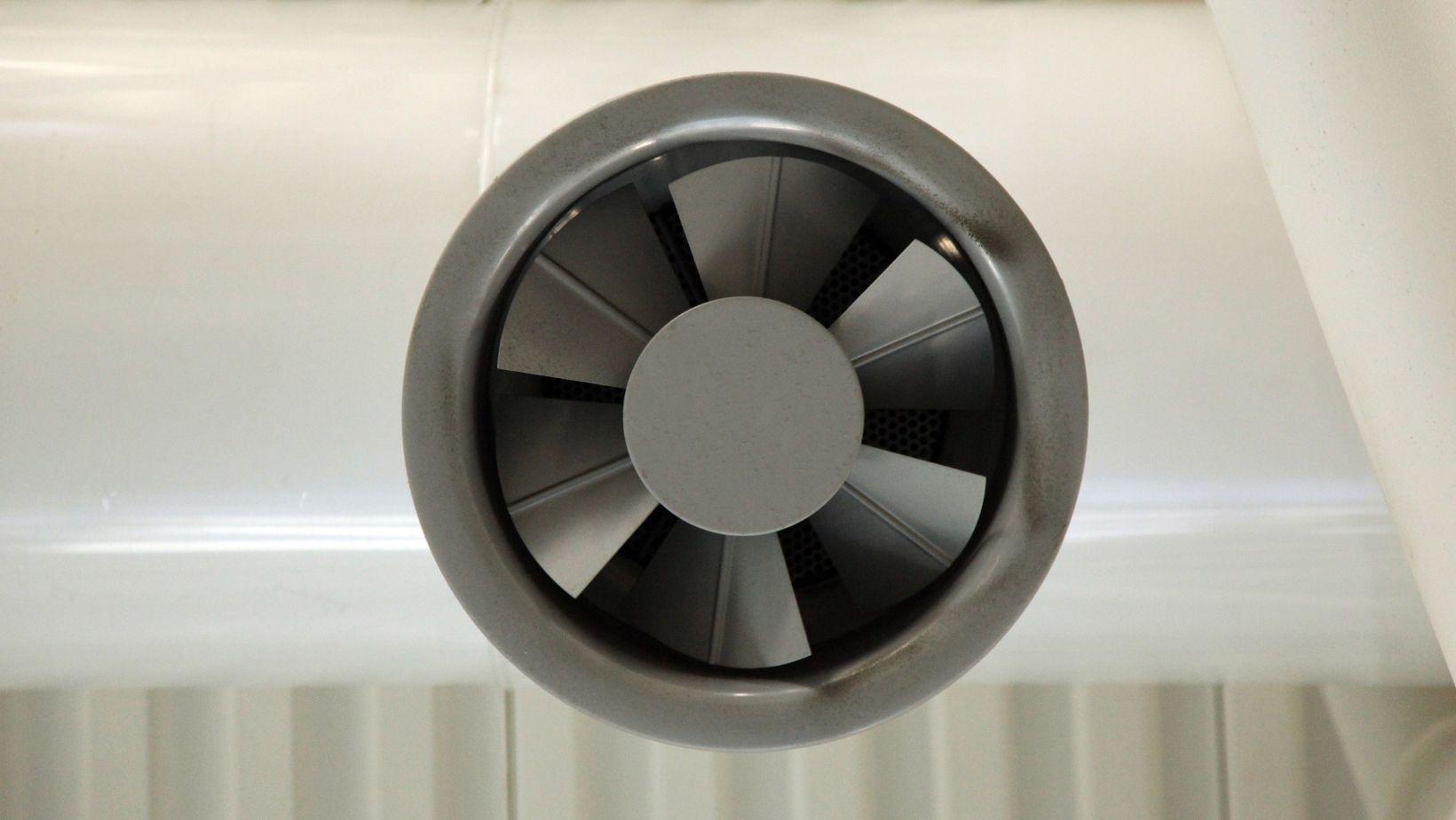
Industrial ventilation often has to solve two problems at once: moving a large volume of air while working within limited installation space. Tube-axial direct-drive fans are designed around this requirement. Their cylindrical housing and axial airflow path allow them to deliver substantial air movement without the larger footprint associated with some other fan configurations. Because the motor connects directly to the fan shaft, the design also eliminates the need for belts and pulleys, simplifying the mechanical arrangement. For facilities where dependable air exchange, compact installation, and straightforward maintenance matter, tube-axial direct-drive fans can be a practical ventilation option.
How Tube-Axial Fans Move Large Air Volumes
A tube-axial fan consists essentially of an axial impeller positioned inside a cylindrical housing. Unlike centrifugal fans, which turn airflow through the housing and discharge it radially, axial fans move air primarily parallel to the shaft. This straightforward airflow path makes them particularly suitable for applications requiring high air volume at relatively low-to-moderate static pressure.
The fan’s performance depends on several interacting factors, including impeller diameter, blade geometry, rotational speed, motor characteristics, and system resistance. As resistance increases because of filters, dampers, ducts, grilles, or other components, the actual airflow delivered by the fan can decrease. Therefore, selecting a fan solely by its maximum cubic-feet-per-minute rating can lead to an unsuitable installation.
Tube-axial construction is especially useful where the fan must fit into a straight duct run or wall opening. The cylindrical housing provides a compact profile, while the axial configuration keeps the airflow path relatively direct. This can be advantageous in industrial buildings where ceiling height, equipment spacing, or available floor area limits ventilation options.
Why Direct Drive Matters in Industrial Ventilation
The defining feature of a direct-drive fan is the connection between the motor and impeller. Instead of using belts and pulleys to transfer rotational power, the motor drives the impeller directly. That difference may appear simple, but it affects maintenance, efficiency, and equipment configuration.
Belt-driven systems contain additional mechanical components that require periodic inspection and adjustment. Belts can stretch, wear, slip, or eventually fail, while pulleys may require alignment. Direct-drive construction removes these components from the power-transmission system. As a result, there are fewer mechanical parts between the motor and impeller that require routine attention.
For facilities evaluating options from Industrial Fans Direct, tube axial direct drive designs can be particularly relevant when equipment access is limited or when reducing routine mechanical maintenance is a priority. However, direct drive does not mean maintenance-free operation. Bearings, motors, electrical connections, impeller surfaces, and mounting hardware still need appropriate inspection according to the manufacturer’s requirements.
Another consideration is motor speed. Because the impeller is directly connected to the motor, changing fan speed may require a compatible motor and control arrangement rather than simply changing a pulley ratio. Variable-frequency drives can provide speed control for compatible motors, but the motor, drive, and fan must be selected as a coordinated system.
Compact Design for Space-Constrained Applications
Industrial facilities frequently have limited room for mechanical equipment. A ventilation system may need to fit between structural elements, within a duct, above a production area, or near an exterior wall. Tube-axial fans can address these constraints because their cylindrical geometry provides high airflow capacity within a relatively compact arrangement.
Their small footprint can also simplify integration into existing ventilation layouts. For example, a fan may be installed as part of a straight-through exhaust system, where contaminated, hot, humid, or stale air needs to be removed from a building. Depending on the application and equipment configuration, tube-axial fans can also be used for supply air, general ventilation, cooling, and process-air movement.
When assessing a compact fan installation, engineers should consider more than the fan’s physical dimensions. Adequate clearance is necessary for airflow and maintenance access. The surrounding ductwork should avoid unnecessary restrictions, and the installation should account for vibration, structural support, electrical access, and safe servicing.
A compact fan that is difficult to inspect or remove can create maintenance problems later. Therefore, the installation layout should balance space efficiency with accessibility—especially in industrial environments where equipment may operate continuously or under demanding conditions.
Selecting the Fan Around System Requirements
Choosing an appropriate tube-axial fan begins with understanding the ventilation system rather than simply selecting a fan based on diameter. Required airflow, static pressure, operating temperature, air density, contaminants, noise requirements, and duty cycle all influence the appropriate configuration.
Several factors deserve attention during the selection process:
- Required airflow: Determine the volume of air that must actually move through the system under operating conditions, not merely the fan’s free-air rating.
- Static pressure: Account for resistance created by ducts, filters, dampers, grilles, transitions, and other components.
- Air characteristics: Temperature, humidity, dust, corrosive substances, and other contaminants can affect material and motor requirements.
- Motor and controls: Confirm that the motor has suitable power, voltage, enclosure characteristics, and compatibility with any speed-control equipment.
- Installation environment: Consider available space, mounting orientation, access for maintenance, vibration control, and environmental exposure.
- Noise and vibration: Evaluate fan speed, impeller balance, mounting, and system design where personnel work nearby.
Fan curves are particularly important because they show how airflow changes as static pressure increases. A fan that appears adequate based on its maximum airflow may deliver considerably less air once connected to a real duct system. Comparing the expected system operating point with the manufacturer’s performance data provides a more reliable basis for selection.
Efficiency, Maintenance, and Operating Reliability
Direct-drive construction can simplify the mechanical side of fan maintenance, but overall efficiency depends on the complete system. A properly selected fan operating near its intended performance range can avoid unnecessary energy consumption caused by excessive pressure, inappropriate speed, or poor system design.
Maintenance should begin with regular visual and operational inspections. Unusual vibration, changing noise levels, reduced airflow, overheating, or unexpected motor behavior can indicate developing problems. Dust and debris accumulating on impeller blades can also affect balance and aerodynamic performance.
Cleaning schedules should reflect the environment. A fan handling relatively clean air may require less frequent cleaning than one exposed to dust, grease, fibers, or process contaminants. Electrical components should be inspected using appropriate safety procedures, and equipment should be isolated from its power source before servicing.
Impeller balance is another important consideration. Accumulated material or physical damage can introduce imbalance, increasing vibration and placing additional loads on bearings and mounting structures. Addressing these problems early can help prevent more serious mechanical failures.
Where Tube-Axial Direct-Drive Fans Fit Best
Tube-axial direct-drive fans are well suited to applications where high air volume, relatively modest pressure requirements, and compact equipment geometry are important. Common uses include industrial exhaust, general building ventilation, equipment cooling, warehouse air exchange, and certain process ventilation systems.
They are not automatically the best solution for every application. Systems with very high static-pressure requirements may call for a different fan configuration, such as a centrifugal design. Likewise, applications involving hazardous atmospheres, extreme temperatures, corrosive chemicals, or combustible dust require careful evaluation of fan construction, motor selection, electrical classification, and applicable safety standards.
The most effective approach is therefore to match the fan’s aerodynamic characteristics to the actual ventilation duty. A well-designed system considers the fan, ductwork, controls, intake and discharge conditions, and operating environment as one connected system rather than treating the fan as an isolated component.
End Note
Tube-axial direct-drive fans offer a practical combination of high-volume airflow, compact construction, and a simplified mechanical drive arrangement. Their value comes from matching those characteristics to the right operating conditions. Careful attention to airflow requirements, static pressure, motor compatibility, installation constraints, and maintenance needs helps ensure that a compact fan performs effectively over its service life. For industrial ventilation, the best selection is ultimately the one that meets the system’s actual demands while maintaining reliable and manageable operation.